
< At-a-Glance Summaries
Date of Publication:
January 2026
Background
Psoriasis is a long-term inflammatory condition that causes discoloured, scaly, itchy patches to form on skin and affects overall quality of life. Because it varies a lot from person to person, it is difficult for doctors to predict who will respond well to which treatment, why some people develop other health conditions associated with psoriasis (e.g. obesity, heart disease, diabetes), and what makes someone’s psoriasis more or less severe. Researchers are looking at molecular data to better understand psoriasis severity and find ways to tailor treatments to individual patients.
What did the researchers do?
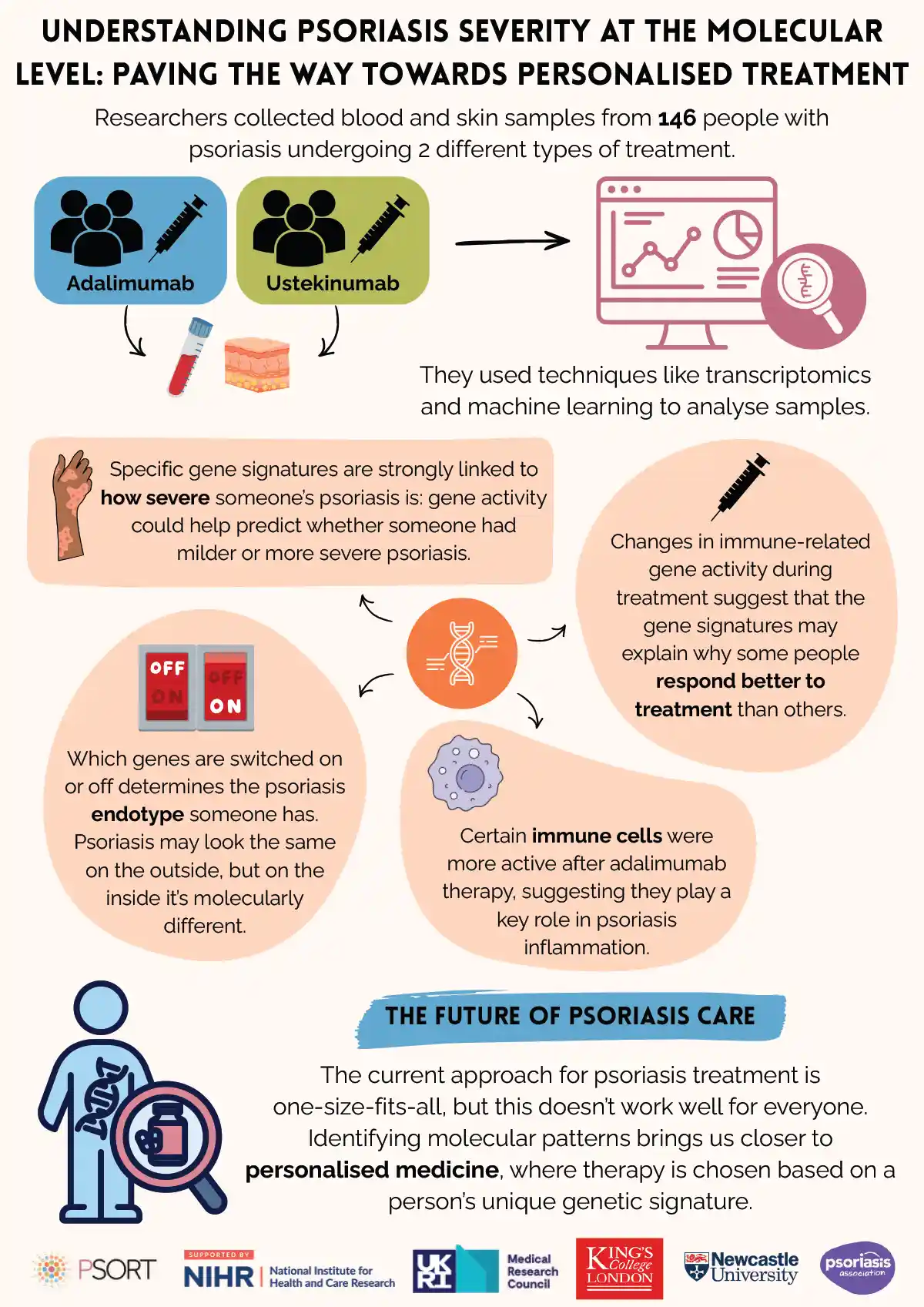
They collected lesional skin (plaques), non-lesional skin (normal-looking skin) and blood samples from 146 people with psoriasis being treated with two different biologic therapies: adalimumab and ustekinumab. Scientists analysed these samples to obtain gene activity data using advanced techniques like transcriptomics (measuring which genes were “switched on” in each place) and machine learning (advanced computer analysis) to spot patterns. They combined this molecular information with clinical data about psoriasis severity and how people responded to treatment.
Key findings
- Analysing which genes were switched on or off in skin samples, researchers found that this condition has distinct molecular subtypes (endotypes), meaning that psoriasis is not one disease – it might look the same on the outside, but on the inside, it is molecularly different.
- Patterns of inflammation are distinct between people depending on how severe their psoriasis is. In other words, two people with psoriasis can have different genetic patterns driving inflammation, which impacts disease severity.
- They identified specific gene signatures that were strongly linked to how severe a person’s psoriasis was. That is to say, the activity of certain genes could help predict whether someone had milder or more severe psoriasis. Most of the genetic signals seen were in skin rather than blood samples.
- Groups of genes work together to produce particular patterns of inflammation, and in some people, protect against having more severe psoriasis. Even though the skin may appear normal (non-lesional skin), there are other metabolic factors influencing skin biology.
- Certain immune cells appeared more active after treatment with adalimumab, suggesting these cells play a key role in psoriasis inflammation.
- The changes in immune-related gene activity during biologic therapy suggest that these gene signatures may also help explain why some people respond better to treatment than others.
Why this matters
Currently psoriasis treatment is often one-size-fits-all, but this approach does not work well for everyone. Identifying molecular patterns in psoriasis brings us closer to personalised medicine, where therapy is chosen based on a person’s unique genetic signature. If we know which treatments are most likely to work (and be the safest or least likely to cause side effects), we can give the right medicine to the right person at the right time. This could improve outcomes and quality of life for people with psoriasis.
For more details, you can read the Newcastle University press release, and the full paper is available to read online here: https://doi.org/10.1038/s43856-025-01325-4
Written by Jade Pizzato
Authors:
Rider A, Grantham HJ, Smith GR, et al
Journal:
Communications Medicine
Link:
< At-a-Glance Summaries