
< At-a-Glance Summaries
Date of Publication:
December 2025
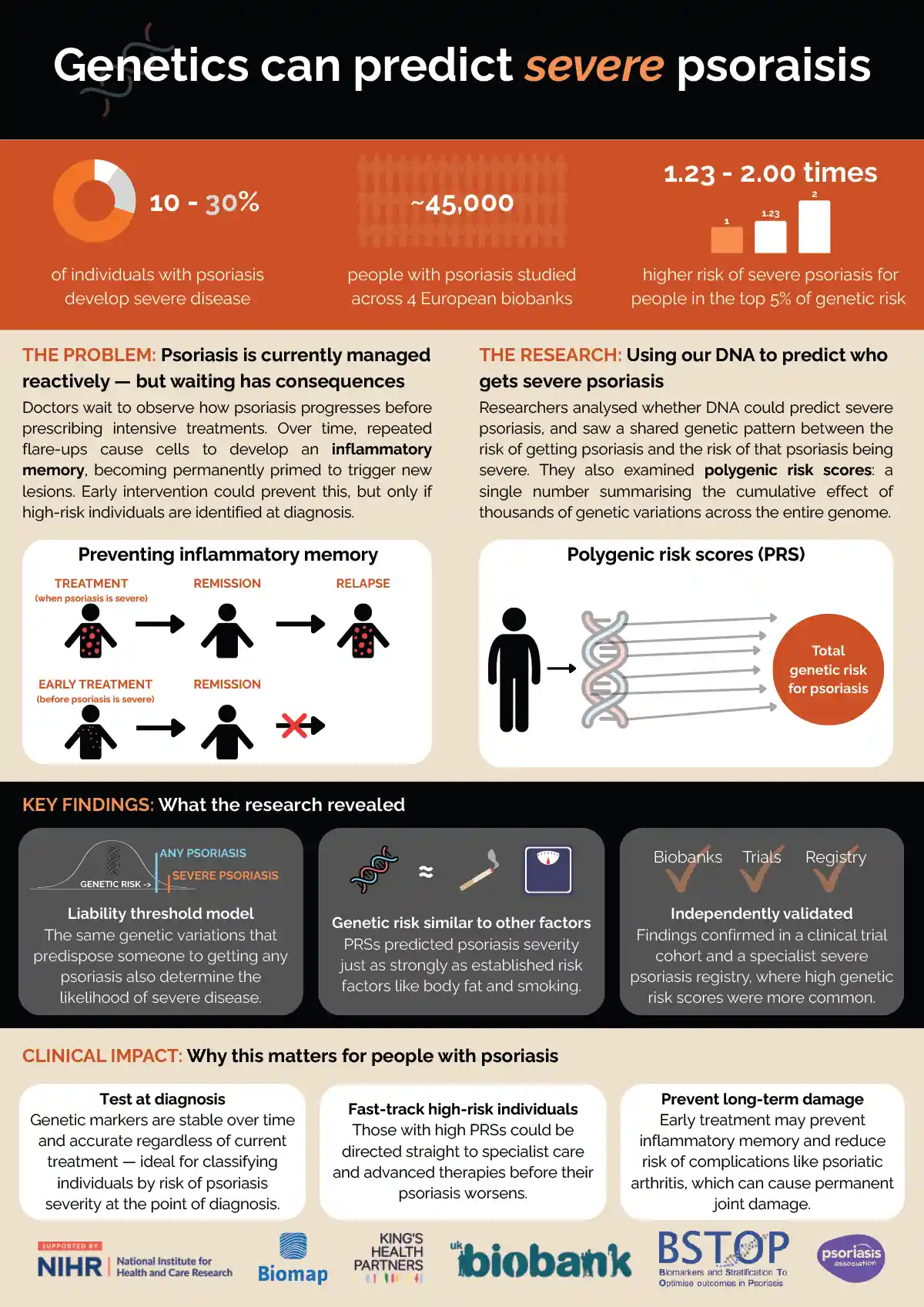
Psoriasis is a common inflammatory skin condition that affects millions of people worldwide, and approximately 10-30% of individuals with psoriasis develop a more severe form of the disease. Severe psoriasis often covers more than 10% of the body’s surface and is linked to a higher risk of other health complications, including psoriatic arthritis, which can cause permanent joint damage if not caught early.
The challenge of early identification
Currently doctors manage psoriasis reactively, waiting to see visible signs of disease worsening before adjusting treatment approaches. This means that mild psoriasis gets weaker treatments, and stronger treatments are recommended when severe psoriasis develops. However, a downside to this approach is that the skin’s natural immunity is shifted by the process of the disease being left to progress and worsen. Essentially, skin develops an “inflammatory memory” where cells become permanently reset to become easily activated, leading to visible psoriasis lesions on the skin. Emerging evidence suggests that earlier treatment could prevent “inflammatory memory” from developing, so if skin isn’t left to get worse before more effective treatments are introduced, there is a better chance that treatments will be effective for longer (i.e. long-term remission). To make this possible, researchers need a reliable way to identify who is at the highest risk for progressing to severe psoriasis when they are first diagnosed.
Using genetics as a predictor
This study involved nearly 45,000 individuals with psoriasis across 4 European biobanks. Researchers investigated whether a person’s DNA could predict severe psoriasis, which was defined by use of systemic treatment and/or hospitalisation. They also analysed ‘polygenic risk scores’ — a number that summarises the cumulative effect of thousands of small genetic variations across a person’s entire genome.
The study found strong evidence for a shared genetic pattern between the risk of getting psoriasis and the risk of that psoriasis being severe. This supports a “liability threshold” model: once a person has enough genetic risk factors to develop the disease, having even more of those same risk factors significantly increases the likelihood that the disease will be severe.
Key Findings
- Genetic vs. lifestyle factors: An individual’s polygenic risk score was found to be just as strong a predictor of psoriasis severity as established lifestyle risk factors like body fat and smoking.
- High-risk groups: Individuals in the top 5% of genetic risk were 23 to 2.00 times more likely to have severe psoriasis than the average psoriasis-affected individual.
- Validation: The findings were confirmed in separate groups of psoriasis-affected individuals, including those in clinical trials and a specialist severe psoriasis registry (BSTOP), where high-risk genetic scores were significantly more common.
Why this matters
Genetic markers are ideal clinical diagnostic tools because they are stable over time, cost-effective to test, and remain accurate regardless of someone’s current treatment or other health conditions. In future, healthcare providers could use these polygenic risk scores to classify individuals by risk of psoriasis severity at the point of diagnosis, before their condition worsens. This would allow doctors to fast-track high-risk individuals toward specialist care and advanced therapies, potentially preventing years of physical discomfort and life-altering complications.
The full paper is available online at: https://doi.org/10.1186/s13073-025-01561-2
Written by Dr Jake Saklatvala
Authors:
Saklatvala JR, Lessard S, Teder-Laving M, et al
Journal:
Genome Medicine
Link:
https://doi.org/10.1186/s13073-025-01561-2
< At-a-Glance Summaries